Bike storage systems: get the bikes off the floor without the wrong rack
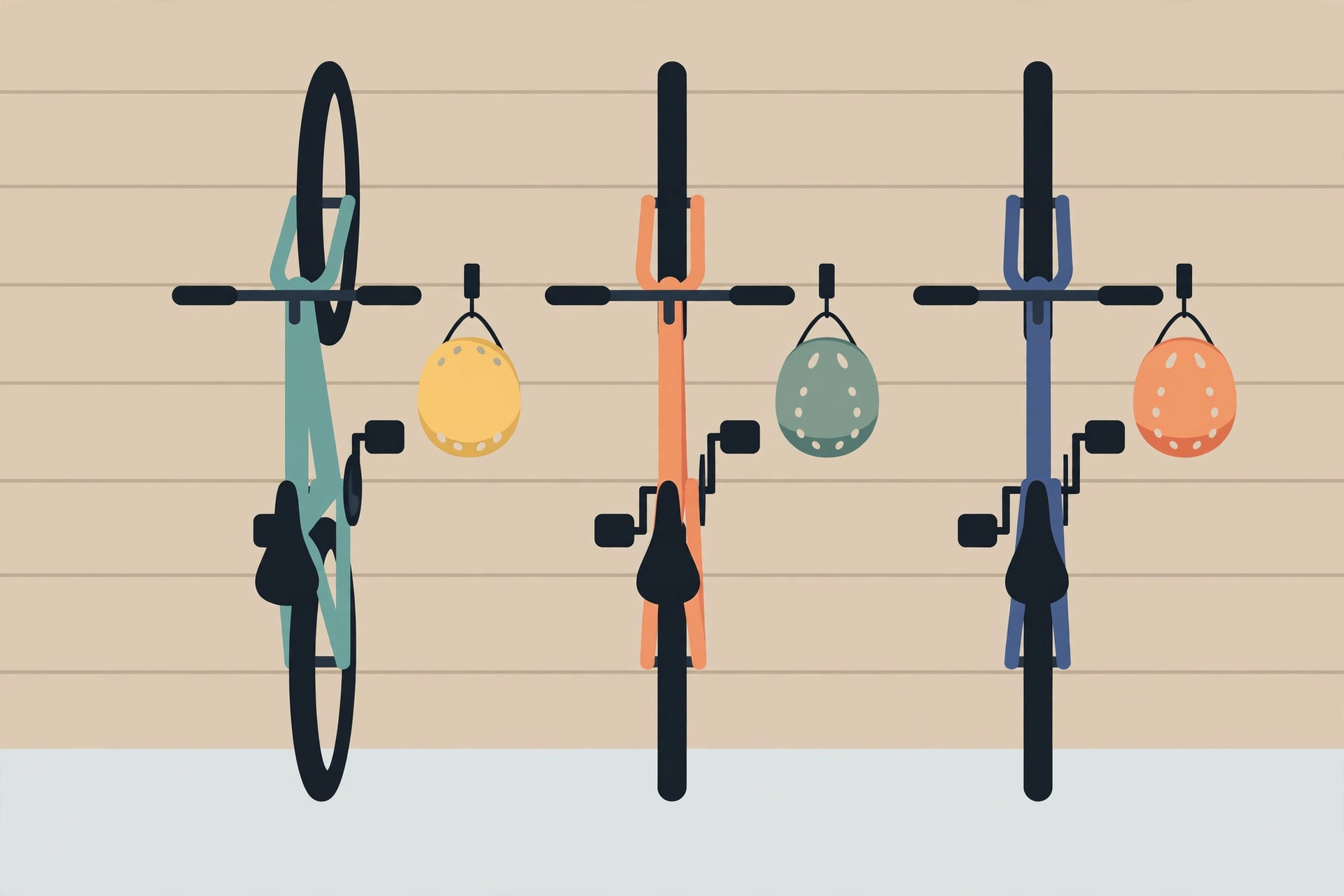
Bikes are the worst-shaped objects in most garages: too long to shelve, too tippy to lean, and always parked exactly where the car door needs to swing. The product roundups will happily sell you twelve racks. What they rarely do is start from your actual constraint, you rent and cannot drill, your e-bike is too heavy to deadlift onto a hook, your kids need to park their own bikes, and eliminate the systems that cannot work. Start there. There are six system types, and your constraint usually leaves two standing.
The six systems, compared on specs that matter
Every figure below is a maker's published rating or a guide's compiled spec, checked October 13, 2026, read capacities the way the roundup itself warns: as the maker's rating, not a promise. Your bike's actual weight and tire width are the numbers that decide fit.
| System | Drilling? | Capacity spec | Floor footprint once stored | Best for |
|---|---|---|---|---|
| Vertical wall hook | Yes, into a stud | Standard hooks typically rated 15 to 20 kg; heavy-duty swivel mounts rated to 66 lb per mount (monTEK listing) | None, wall only | One or two adult bikes, owners happy to lift |
| Pivoting no-lift wall rack | Yes | Steadyrack Classic: up to 35 kg, 160-degree pivot, folds flat, no-lift loading | None, wall only | Heavy bikes and e-bikes; riders who should not deadlift a bike overhead |
| Gravity lean-to stand | No, leans against the wall | Delta Michelangelo: two bikes, up to 80 lbs total | Shallow, the bikes' width against the wall | Renters; two-bike households; anyone who reorganizes often |
| Floor rack (slotted stand) | No | Simple Houseware 5-bike rack: five slots, fits 12 to 26 inch wheels | Full, every bike keeps its floor rectangle | Kids' bikes and high-turnover family fleets where bikes roll in and out daily |
| Wall rail system | Yes, rail into studs or masonry | Ultrawall 6-bike rail: 48-inch rail, hooks slide to custom spacing, up to 300 lbs total on the maker's listing | None, wall only | Four-plus-bike households; mixed adult and kids' sizes on one wall |
| Ceiling hoist | Yes, into ceiling joists | Pulley systems such as the RAD Sportz hoist; one budget-guide roundup puts hoist capacity at up to 100 lbs | None, ceiling only | Seasonal or rarely ridden bikes in high-ceiling garages |
A seventh option, the freestanding vertical stand, splits the difference: no drilling, bikes stored upright, some models on lockable rolling casters and fitting tires up to 4 inches wide. It costs floor space, a stand's base, but far less than a floor rack, and it moves when the garage layout changes.
Do the floor-space math before admiring the hardware
"Saves space" is meaningless until you say which space. A bike on a floor rack occupies its full length-by-width rectangle, plus the walk-around room to roll it in and out. The same bike on a vertical hook occupies wall width only, the floor rectangle comes back entirely, which is why vertical systems are the default answer in single-car garages. A gravity stand is the honest middle: the bikes still lean at an angle, so you recover most of the rectangle but not all of it. A hoist recovers everything but spends the one currency a floor rack never touches, your willingness to raise and lower the bike every single ride. Measure your own bikes (length, and the width at the handlebars) and multiply by the count: that rectangle is what any wall or ceiling system returns to you, and it is the number to compare against the price of the hardware.
Verify three specs, not one
The spec mistake that breaks these purchases is reading a single capacity number. There are three, and all three must fit your bike:
- Per-hook (or per-mount) rating. This is what one bike may weigh. A swivel mount rated at 66 lb per mount handles most e-bikes; a standard hook at 15 to 20 kg may not. Weigh the bike, bathroom scale, you plus bike minus you, before trusting a guess.
- Total system rating. A rail's headline number is for the whole rail: 300 lbs total across six hooks is not 300 lbs per bike, and six heavy bikes can exceed a total rating while each one fits the per-hook rating comfortably.
- Tire width. Hooks and cradles have a maximum tire width, 3.5 inches on the monTEK mount, up to 4 inches on the freestanding stand above. A fat-tire bike that exceeds it will not seat in the hook no matter what the weight rating says.
This is the spec-verification habit: the listing page for the exact model, three numbers, checked against your heaviest and widest bike. Five minutes there beats a return shipment and two patched drill holes.
Choose by constraint: the decision framework
- "I rent / can't drill." Gravity stand or freestanding vertical stand. Both hold bikes with zero holes; the gravity stand's lean design needs no drilling at all.
- "My bike is heavy, an e-bike I can't lift high." The pivoting no-lift rack exists for exactly this: the bike rolls in at ground level and the rack's pivot does the work. A floor rack is the zero-lift fallback.
- "Kids park their own bikes." Floor rack, or wall hooks mounted low, wall systems can be installed at different heights for adult and children's bikes, but a rack a child can roll into beats a hook a child cannot reach and will not use.
- "We have four or more bikes." A wall rail: hooks slide to custom spacing, so a road bike, two hybrids, and a kids' bike share one wall at staggered heights instead of fighting for separate studs.
- "One bike, ridden twice a year." The hoist. Maximum space recovered, and the lift-and-lower effort is amortized over two rides a year instead of two a week.
Install the wall systems safely
Wall systems are only as good as their fixing. The standard procedure from hook makers: mark each mounting hole, drill roughly 1/4-inch diameter holes about 1-3/4 to 2 inches deep, checking first that you are not drilling into electrical wiring, then secure with lag screws and flat washers, into a stud wherever the system allows. Two more details that protect the bike rather than the wall: hang by the front or back wheel as you prefer (both are fine for the bike's structure; the front wheel is the common choice for balance), and use a padded hook so the rim is not scratched over months of hanging. Published price ranges for these systems, per a budget guide checked October 13, 2026, run roughly $20 to $100 for wall-mounted systems, $25 to $50 for ceiling systems, and $40 to $80 for freestanding racks in US dollars, enough range that the constraint, not the price, should make the decision.
FAQ
Does hanging a bike by one wheel damage it? Per hook makers, no, front or back wheel is fine for the bike's structural integrity. Use a padded hook to protect the rim finish.
How many bikes fit on one wall? A 48-inch rail system is rated for up to six bikes with sliding hooks, but the total weight rating, not the hook count, is the real limit. Staggering handlebar heights is what makes tight spacing usable.
What if my garage walls are masonry? Rail systems ship with hardware options for stud or masonry; hooks need the right masonry anchors. Match the fixing to the wall, not just the rack to the bike.
Is a floor rack ever the right answer? Yes, for kids' bikes, daily-ridden family bikes, and anyone who values roll-in simplicity over floor space. Not every garage needs its floor back.