Cold-weather garage storage: what to move indoors before the first freeze
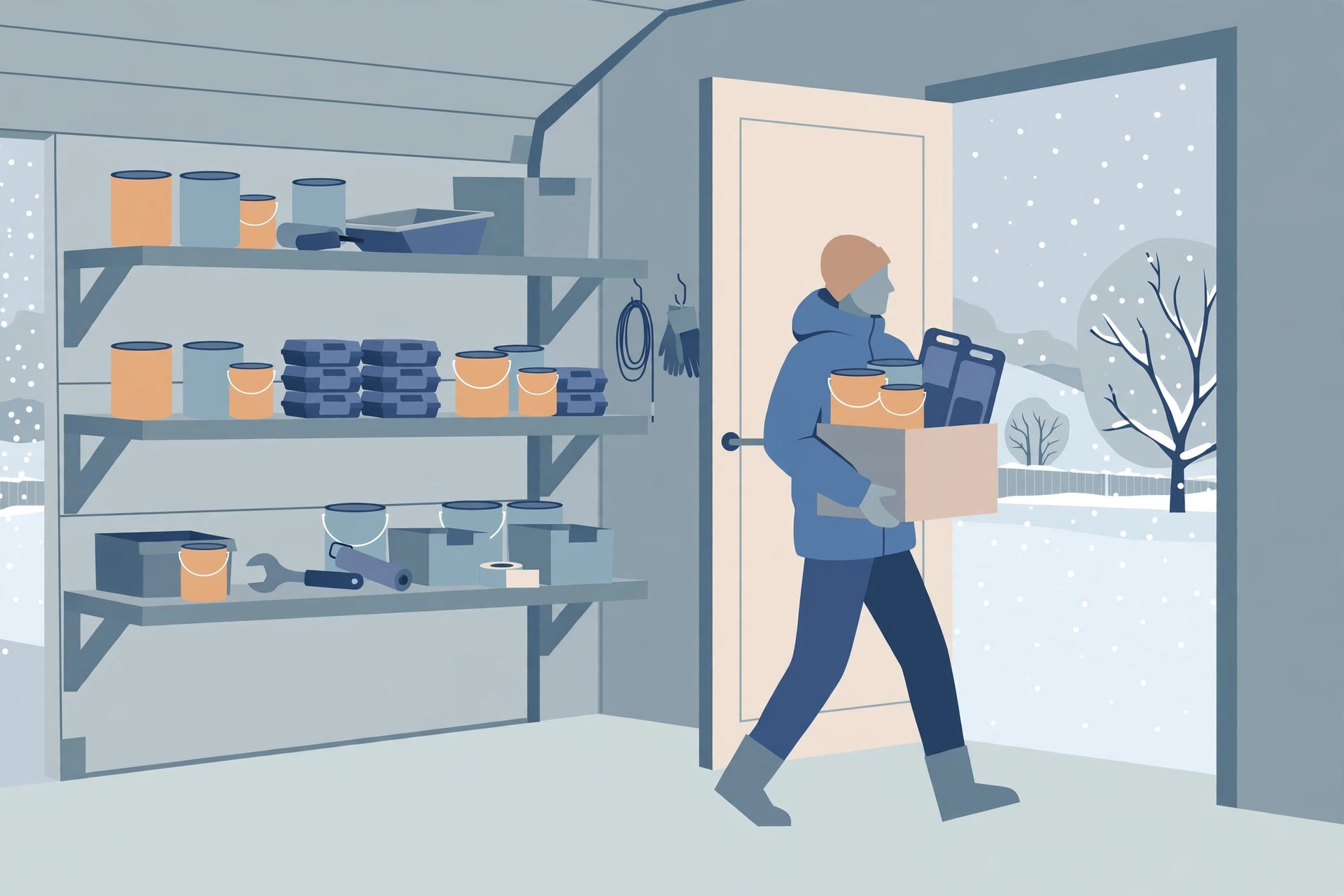
Every fall, the same listicles circulate: fifteen things never to store in a garage, paint rubbing shoulders with propane, electronics next to firewood, no temperatures attached to any of it. The list is not wrong, exactly, it is useless in a specific way. It never separates the three different things that actually go wrong in an unheated garage, and because it never separates them, it cannot tell anyone what to do first. Some products are ruined outright by one freeze. Some lose performance in the cold and recover indoors, but carry hard charging rules that have nothing to do with storage. And one common garage item is not a cold problem at all: it is a safety rule about enclosed spaces that applies in July exactly as it does in January. Sort by failure mode and the October job becomes a single pass with a short list, instead of a vague worry about everything on the shelves.
The threshold table: what the makers actually specify
Every limit below comes from the maker's own document, a paint data sheet, a tool manual, a government safety sheet, checked October 16, 2026. Where a maker gives a range, the range is the rule. Where no maker range exists, this guide says so rather than borrowing a number from a listicle.
| Category | Maker / official limit | What the cold does | October action |
|---|---|---|---|
| Water-based paint | Sherwin-Williams acrylic data sheet: store indoors at 40°F to 100°F. BEHR data sheet caution: protect from freezing | Ruined: freezes below 32°F and separates into an unusable state | Move to a space that stays above freezing for the whole winter |
| Lithium-ion tool batteries | DeWALT manual: charge at 65°F to 75°F air temperature for best life; never charge below 40°F or above 104°F. Milwaukee manual, storage over 30 days: below 27°C, away from moisture, at 30 to 50 percent charge | Performance drops in the cold; charging a frozen pack risks serious damage | Bring packs and chargers indoors; store part-charged; warm a cold pack before charging |
| Propane cylinders | Superior Propane and Alberta government guidance: never store a cylinder indoors or in an enclosed area such as a garage; store outside, upright, at least 3 metres (10 feet) from ignition sources | Not a cold failure at all, an enclosure rule, in every season | Move cylinders outside to a ventilated spot, upright, valve capped |
| Other water-based liquids | No single maker range; the category rule is physical: water-based contents freeze at about 32°F and expanding contents can crack the container | Separation, thickening, split containers discovered in spring | Move the valuable and the messy indoors; leave cheap replaceables at your own risk |
Paint: ruined, not just cold
Water-based paint is the one category where a single hard freeze ends the story. The chemistry is simple: the paint is mostly water, water freezes below 32°F, and a frozen can of latex paint separates into a lumpy state that stirring does not reliably repair, the loss is usually discovered in spring, mid-project, when the replacement costs a trip and a colour match. The makers say it plainly on their data sheets. Sherwin-Williams' acrylic coating data sheet instructs storage indoors at 40°F to 100°F; BEHR's exterior paint data sheet carries the caution to protect the product from freezing, and gives an unopened shelf life of two years under normal conditions, normal meaning stored within range. Forum threads are full of the counter-example: one owner describes losing water-based paints to an unseasonable cold snap into the negative twenties, simply because it never occurred to them that paint needed protection. The same thread's working consensus matches the data sheets: water-based paints above 32°F as an absolute floor, and oil-based paint, which tolerates cold better, still kept above roughly 40°F. Note the margin in the official range: 40°F, not 33°F. A garage that dips to 36°F on a cold night is inside the freeze risk for the can's contents even if the air never quite reaches freezing at the thermometer, because the floor and the exterior wall run colder than the room. Half-used cans deserve the move most: the product is already opened, its remaining life is shorter, and it is the can most likely to be needed for a spring touch-up.
Batteries: performance now, charging rules always
Cordless tool batteries fail differently, and the difference matters. A lithium-ion pack left in a cold garage is mostly not ruined, it is slow, weak, and short-lived until it warms up. The damage risk sits in the charging, not the sitting. DeWALT's manual states the working window directly: the best life and performance come from charging at an air temperature of 65°F to 75°F, and the pack must not be charged below 40°F or above 104°F, because charging outside that window can seriously damage the battery. That single rule explains the most common winter complaint, a pack that "died" over winter after being topped up on a freezing January morning in an unheated garage. For storage itself, Milwaukee's manual gives the long-term recipe: for storage longer than 30 days, keep the pack where the temperature is below 27°C and away from moisture, store it at 30 to 50 percent charge, and charge it as normal every six months of storage. The same manual warns that temperatures above 50°C reduce pack performance, which is the summer half of the same lesson, the garage is the wrong room at both ends of the year. The practical translation: batteries and chargers move indoors in October to a shelf or cabinet, packs go away part-charged rather than full or empty, and any pack brought in cold gets time to reach room temperature before it goes on the charger. The tools themselves can stay in the garage; it is the packs and chargers that carry the rules.
Propane: not a cold rule at all
Propane appears on every never-store list, usually between the paint and the paperwork, which badly undersells it. The official position is not "cold garages are bad for propane." It is categorical and season-free. Superior Propane's safety sheet states it in capitals in the original: never store or place a propane cylinder indoors or in an enclosed area such as a basement, garage, or shed. Alberta's government cylinder safety tips say the same thing from the storage side: cylinders are stored outside, in an upright position, and are not stored indoors. The rest of the official handling is just as specific. Keep cylinders at least 3 metres, 10 feet, from any open flame or source of ignition. Seal the valve outlet with a cap or plug when the cylinder is not connected. And in Canada, a refillable cylinder must be requalified or replaced every 10 years after its date of manufacture, so the October move is the natural moment to read the date stamped on the collar of the barbecue tank before it goes to its outdoor spot. Cold, by itself, is not the cylinder's problem, outdoor winter storage is its designed condition. The garage is the problem, because a slow leak in an enclosed space collects instead of dispersing. If a spare cylinder has been living in the garage, moving it out is the single highest-value step in this entire guide, and it takes five minutes.
The October audit: one pass, in order
- Move propane first. Every cylinder out of the garage, shed, and basement, to a ventilated outdoor spot, upright, valve capped, at least 3 metres from ignition sources. Check the manufacture date while each cylinder is in hand.
- Sweep the paint shelf. Every water-based can, paint, primer, stain, water-based finishes, goes to an indoor space that stays above 40°F. Check each can's data sheet range if the brand is unfamiliar.
- Bring in the batteries and chargers. Set packs to a part charge (roughly a third to a half) for storage, keep them dry and off any surface that floods, and calendar a normal charge every six months for anything stored that long.
- Triage the remaining liquids. Cleaners, car wash, windshield fluid concentrates and canned goods: anything water-based, valuable, or capable of making a mess if its container splits moves indoors. Hardware that stays in the garage goes off the concrete floor and into a closed cabinet, which buffers the temperature swings.
- Leave a note on the garage shelf, what moved, and where it went. The spring version of this job is mostly remembering where the paint is.
What success looks like: the garage holds no propane cylinders at all, no water-based paint, and no battery chargers; the batteries are indoors at part charge; and the shelf note lists every moved item's new home. If the first freeze arrived tonight, nothing left in the garage would be ruined by it, and nothing in the house is stored somewhere its own data sheet forbids.
FAQ
Paint froze once. Is it always garbage? The consistent guidance is that frozen latex paint separates and is generally unusable; thawing and stirring produces, at best, an unreliable finish. The data-sheet answer is prevention, storage at 40°F to 100°F, not rescue.
Is it safe to charge tool batteries in the house? That is where the manuals' numbers point: charging is specified at ordinary indoor temperatures (65°F to 75°F for the best life, per DeWALT, and never below 40°F). Use the maker's charger, keep contacts clean, and let a cold pack warm up first.
The barbecue tank has always lived in the garage. Is outside really better in winter? Yes, that is the official guidance, not a preference. Cylinders are built for outdoor storage, upright and ventilated; enclosed spaces are the hazard, in every season.
What about an insulated cabinet in the garage instead of moving things? A closed cabinet off the concrete floor genuinely buffers swings and is a reasonable second-best for marginal items. It is not a substitute for the three hard rules: paint still needs a reliably above-freezing space across the whole winter, chargers still need their temperature window, and propane does not belong in the garage in any cabinet.