Garage floor containment mats: buy by containment, not by coverage
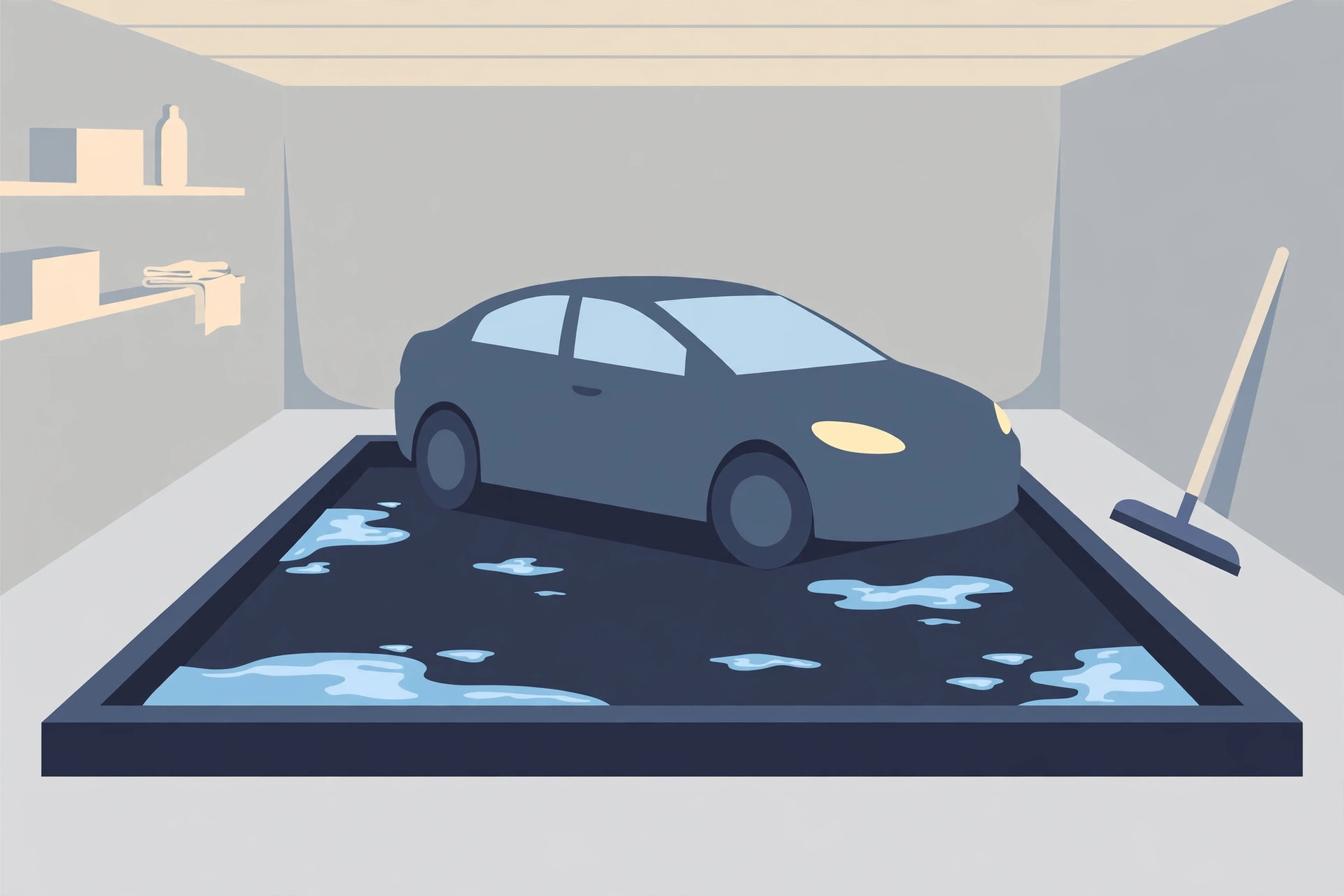
A garage floor mat is sold like a rug and used like a tray. That mismatch is where most purchases go wrong. Shoppers compare dimensions and price, unroll the biggest mat that fits the bay, and then discover the real questions were different: how much meltwater the mat can hold before it overtops an edge, whether the edge is a designed wall or a hopeful crease, and where the water goes when it is time to empty the thing. A containment mat's job is narrow and specific, catch everything that melts and drips off a winter vehicle, hold it on the mat instead of letting it spread across the slab, and give it back on cleaning day. October is when to set one up: before the first slush, while the floor can still be cleaned and dried underneath it.
The winter problem is standing salt water
It helps to know exactly what the mat is preventing, because "protects your floor" is doing a lot of unexamined work in most listings. Concrete guidance from Concrete Alberta is specific about the mechanism. Scaling, the surface of the slab flaking and peeling, is made far more severe when water or salt water is allowed to stand on the surface for extended periods, and the guidance states plainly that even salts carried in on cars may cause severe scaling of garage slabs and driveways. The same guidance warns against using deicing salts on new or recently placed concrete at all, and against ever using ammonium sulphate or ammonium nitrate as a deicer, because those chemicals attack concrete directly. A parked car delivers the exposure nightly all winter: snow packed in wheel wells and underbody trays melts in the relatively warm garage, carries road salt with it, and leaves a brine puddle sitting on the slab for hours. A containment mat does not stop the melting. It changes where the puddle stands, on a waterproof sheet with a raised edge, instead of in the pores of the concrete through another freeze-thaw cycle. That is the whole case for the product, and it is a good one. It also explains the mat's limits: a mat protects the rectangle it covers, and only if the meltwater actually stays on it.
Mat types compared on verified specs
Figures are the makers' and retailers' published specifications, checked October 16, 2026. Prices are dated the same day and in US dollars; mat pricing runs on seasonal sales, so confirm the live figure before ordering.
| Mat | Size and containment spec | Edge and construction | Price checked Oct 16, 2026 |
|---|---|---|---|
| AutoFloorGuard Compact | 7 ft 6 in by 16 ft; 23 lbs; holds up to 64 gallons | Watertight heat-sealed seams; no assembly; 1-year warranty | US$147.19 at the maker's store (regular price US$219.99) |
| AutoFloorGuard Mid-Size | 7 ft 6 in by 18 ft; 26 lbs | Built-in containment edge; heat-sealed, thermal-welded seams; Stay-Put Corners; free squeegee included; 1-year warranty | US$189.99 at the maker's store (regular price US$259.99) |
| TruContain (retailer guide) | Sold in several sizes through Garage Flooring LLC | Commercial-grade PVC; raised edges of 1.18 inches around the perimeter; textured non-slip surface; unrolls ready to use | Not price-checked for this guide |
| Floor Guard (Winkler Canvas) | Custom sizes available; maker recommends at least 6 inches larger than the vehicle all around | 1-inch foam sidewall; waterproof; resistant to sand, salt, road sludge, and stains from oil and antifreeze; anti-skid rough side up; 1-year limited warranty | Custom-priced; not price-checked for this guide |
Two patterns show up in the specs. First, edge height is the real containment number: an inch of foam sidewall or 1.18 inches of raised PVC edge is a wall a puddle must climb, while a flat roll-out mat with no raised edge is a floor covering, not a containment device, useful against drips and stains, but meltwater walks off it. Second, warranties in this category are short: both makers above offer one year, which argues for judging the mat on seams and material rather than on longevity promises.
Do the containment math
The compact AutoFloorGuard's published capacity, up to 64 gallons, is the number to think with. A vehicle coming in from a slushy commute carries meltwater in the wheel wells, along the underbody, and packed behind the wheels; it does not arrive as 64 gallons, but it also does not arrive once. The mat fills across days, not minutes: each parking adds its share, and evaporation in a cold garage is slow. The capacity figure is therefore best read as a cleaning interval, not a flood rating. A mat that holds weeks of ordinary melt gives time to squeegee it out on a mild day; a mat near its edge after one storm is telling you it is undersized for the vehicle or the climate, or that the car is being parked off-centre and one corner is doing all the work. The other half of the math is the low corner: water on a mat obeys the slab's slope, and garage slabs slope toward the door or a drain. The edge that matters most is the downhill one, and it is the first place to inspect after the first melt.
Size it with the 6-inch rule
Sizing is where the category's advice contradicts itself, so it is worth taking the maker's version seriously. Winkler Canvas, which builds the foam-sidewall Floor Guard, gives the rule directly: the mat should be at least 6 inches bigger than the vehicle all the way around, and bigger is not automatically better. Their reasoning is practical, not commercial. An oversized mat means stepping into the accumulated slush every time you get out of the car, and tripping over excess mat while unloading groceries or working around the vehicle. The same maker recommends one mat per vehicle rather than a single large mat under two cars, for easier cleaning and so nobody has to walk through the sludge collected between the cars. Measured against the standard sizes, the rule is a measuring exercise, not a guess: measure the vehicle's length and width including mirrors, add a foot to each dimension (6 inches per side), and buy the smallest standard size that clears both numbers. For a compact car that lands on the 7 ft 6 in by 16 ft class; a longer vehicle pushes to the 18 ft mid-size. Buying a size up "just in case" buys the slush-stepping problem the maker warns about.
Choose by vehicle, tires, and drainage
- Studded tires: a deciding constraint, not a detail. Winkler Canvas states plainly not to use studded tires on its mat, studs can puncture it and leak the contents onto the floor. If the winter vehicle runs studs, a containment mat is the wrong tool; protect the slab with sweeping, squeegeeing, and prompt meltwater removal instead.
- Two vehicles: two standard mats beat one oversized mat, per the maker's own recommendation above, each empties and cleans separately, and the walkway between the cars stays dry.
- How the water gets out: the AutoFloorGuard mid-size ships with a squeegee and telescoping pole, which signals the intended routine: push the meltwater off the open end or out the door, then let the mat dry. If your slab slopes the wrong way and there is no door-side exit, plan on a shop vac instead, both makers list it among the cleaning tools.
- Floor underneath: the mat goes down on a clean, dry slab. Trapping a dirty, damp floor under a waterproof sheet for five months preserves the mess, not the floor.
Put it down and keep it working: the procedure
- Sweep and wash the bay, and let the slab dry fully before the mat goes down.
- Unroll or unfold the mat and let it lie flat. The Floor Guard maker notes wrinkles smooth out after a few days lying flat; do not fight them on day one.
- Centre it under the vehicle's parking position using the 6-inch rule, with the anti-skid rough side up where the maker specifies one.
- Set any stay-put corners or corner fasteners so tires turning on the mat do not walk it sideways over the season.
- After the first melt, inspect the downhill edge and corners for overtopping or leaks, and adjust the parking position before the pattern sets in.
- Empty it on a rhythm, not on a crisis: squeegee or shop-vac the collected meltwater out regularly. For a full clean, the makers' methods agree, mild soap and water, a mop, squeegee, or garden hose, with a pressure washer listed as an option on the Floor Guard.
What success looks like: after a slushy week, the brine is on the mat and the slab around it is dry; the downhill edge shows no overflow tracks; nobody steps in slush getting out of the car; and the spring wash-down is a mat cleaning, not a concrete repair conversation.
FAQ
Will a mat damage an epoxy or sealed floor? The makers design these mats for use over bare and coated concrete, but the standing rule applies: start with a clean, dry floor and lift the mat at season's end to check what collected underneath.
How long do containment mats last? Both makers in the comparison carry a 1-year warranty, and the vulnerable points are seams and punctures. Heat-sealed, thermal-welded seams are the spec to look for, and the reason studded tires rule the product out entirely.
Can one mat serve two cars? Makers advise against it. Winkler Canvas recommends a separate mat per vehicle for easier cleaning and to keep the walk between cars out of the collected sludge.
Is a flat roll-out garage mat the same thing? No. A flat mat protects against drips and stains but has no raised edge, so meltwater spreads off it onto the slab, the standing salt water the containment mat exists to prevent.